From commercial trail of Everest base camp, Annapurna base camp, to remote trails of Kanchenjunga and Gorkha Manaslu trail. Adventure here was defined or measured by altitude gained and distance covered. But today a quiet shift is taking place.
Lately, more visitors to Nepal are choosing for cultural excursions over strenuous hikes because they are more interested in learning about the country, its people, and its centuries-old traditions than in walking a great distance. This is particularly true in areas like Upper Mustang, where culture is still equally important as the natural environment.
From High-Altitude Challenges to Human Stories
Extreme trekking have always been attracting adventurers from all over the world. Either is high altitude trekking, mountaineering or extreme camping high up in the Himalayas. Lately, travelers are re defining with motorcycle adventure, 4×4 adventure and even mountain biking on the trails, once accessible by foot only with help of pack of animals. Instead of pushing towards to higher elevation they seek comfort and connection to High altitude human stories. They are seeking:
- Ancient monasteries carved into cliffs.
- Walled cities that once guarded trade routes.
- Villages where daily life follows centuries-old rhythms.
- Spiritual traditions shaped by Tibetan Buddhism.
In places like Upper Mustang, cultural travel offers something rare: a chance to step into a living Himalayan civilization rather than pass through it.
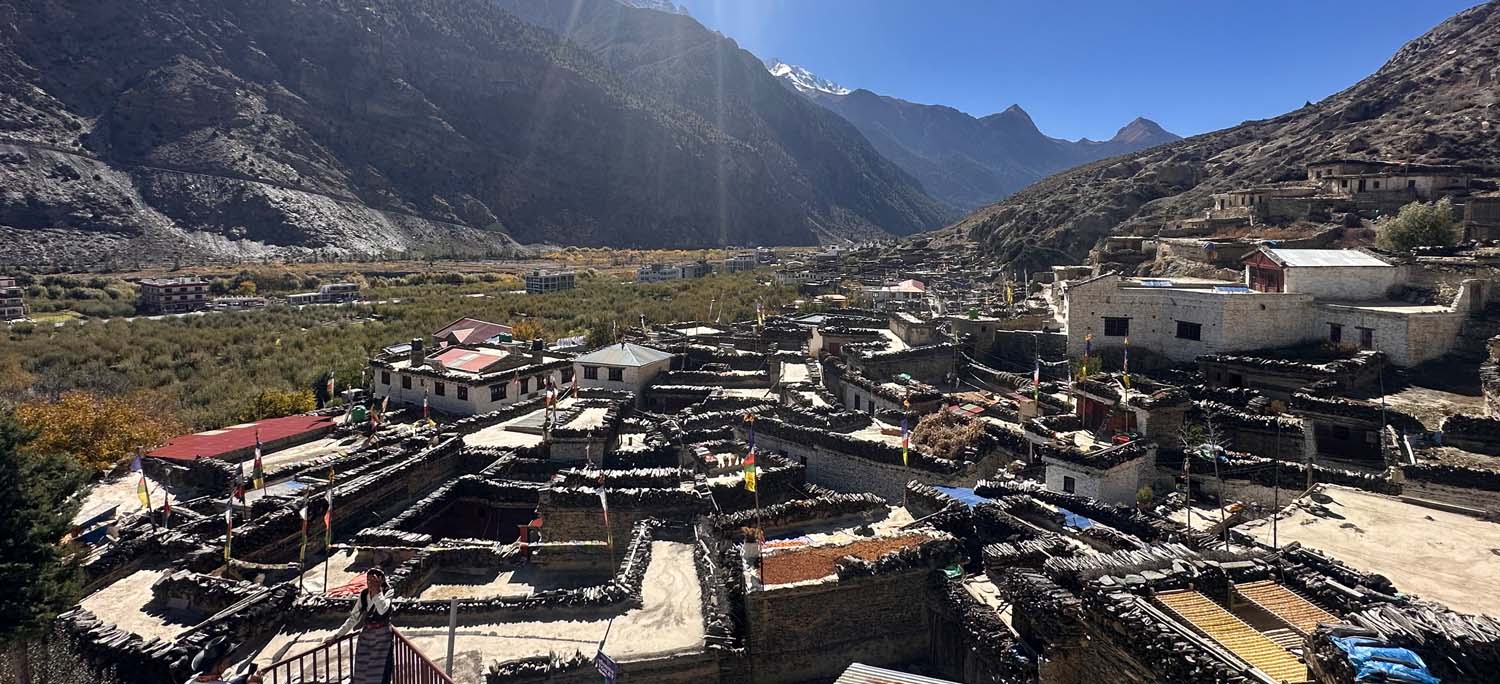
While in high altitude the air is thinner, the movement is slower and silence is the thing that carries the weight. While travelers counting the oxygen level, local community measure life in season and survival. Children walk long across the vast open valley, people turn prayer wheels with devotion and pass down to generations. Simple food shaped by scarcity and centuries of adaptation. Everyday life reflects resilience learned early and practiced quietly.
The route remembers that once salt caravans that formerly passed through these valleys connecting Tibet and Nepal, a monk talks of monasteries that survived time and isolation, and a farmer remembers winters when snow blocked every path. Here, faith is connected with farming, travel, and survival itself; it is not detached from life. Prayer flags spread across high passes, butter lights burn inside monastery, and hospitality begins with warm tea, basic meals, and a sincere welcome remains consistent despite little resources.
The Himalayas are not characterized by extremes, as travelers who slow down and sit and listen instead of hurrying onward and start to realize. What stays with travelers, long after the journey ends is not the height of the mountains, but the quiet dignity, endurance, and humanity of the people who call this high world home.
Upper Mustang: A place where Culture takes center Stage
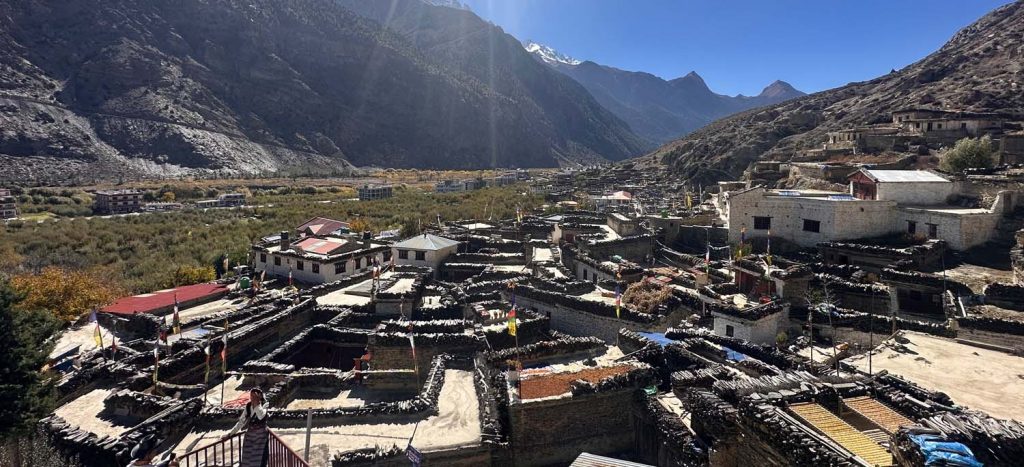
One of the best illustrations of why culture-focused travel is becoming more popular in Nepal is Upper Mustang. This trans-Himalayan region, often referred to as the Last Forbidden Kingdom, feels more like a cultural time capsule than a trekking destination.
Travelers exploring Upper Mustang by jeep or on gentle walks experience:-
- The ancient walled city of Lo Manthang, the cultural heart of Upper Mustang and former capital of the Kingdom of Lo.
- Cliff caves of Upper Mustang carved into high rock faces, historically used for meditation, shelter, and survival.
- The striking red rock formations of Dhakmar, associated with Tibetan Buddhist legends and sacred history.
- Remote villages such as Ghami and Charang, showcasing traditional Himalayan architecture and preserved local life.
- Centuries-old Tibetan Buddhist monasteries where daily rituals and spiritual practices continue uninterrupted.
- Prayer flags and chortens along high mountain passes of Upper Mustang, symbolizing faith and protection.
- Vast trans-Himalayan desert landscapes with the views of the Annapurna and Dhaulagiri ranges.
- Ancient salt trade routes that once connected Nepal and Tibet through the Mustang region.
- High-altitude lifestyle shaped by isolation, resilience, and sustainable Himalayan living.
- Authentic local hospitality experienced through village stays and cultural interactions.
- Quiet stone-paved alleys, monastery courtyards, and open valleys. Rugged off-road journeys forming the core adventure of an Upper Mustang Jeep Tour, offering access without long-distance trekking
- Historic monasteries of Lo Manthang, including some of the oldest gompas in the trans-Himalayan region
- Monasteries adorned with ancient murals, Thangka paintings, and butter lamps, reflecting deep Himalayan spiritual heritage
Here, the journey isn’t about reaching a summit. It’s about understanding how isolation, faith, and geography shaped a resilient Himalayan culture.
Why Culture-Focused Travel Feels More Meaningful
- Deeper connection with local communities
Cultural trips allow travelers to interact with monks, farmers, artisans, and village elders – not just guides and fellow trekkers. Conversations, shared meals, and observation of daily life create lasting impressions that go far beyond physical achievement.
- Slower, More Immersive Travel
Unlike demanding treks with fixed distances, culture-focused Himalayan journeys encourage a slower pace. Time is spent exploring monasteries, attending local festivals, and walking through ancient settlements rather than racing against daylight or altitude.
- Adventure without Physical Extremes
Traveling through rugged Himalayan terrain by jeep, crossing high mountain passes, and navigating remote valleys still delivers adventure but without the physical strain of long, high-altitude treks. This makes cultural travel more accessible to a wider range of travelers.
Redefining Adventure in Nepal
Adventure in Nepal no longer has a single definition.
For some, it will always mean long treks and high-altitude challenges. But for many others, adventure now means:
- Entering remote Himalayan kingdoms
- Learning ancient traditions shaped by isolation
- Experiencing spirituality, history, and daily life firsthand
- Cultural travel through regions like Upper Mustang proves that you don’t need to climb higher to go deeper.
A New Era of Himalayan Travel
The growing preference for culture-focused trips reflects a broader change in how people travel. As travelers become more experienced and mindful, they seek journeys that offer meaning, not just milestones.
In Nepal, especially in culturally rich regions like Upper Mustang, the most powerful adventures are often found not on the toughest trails, but in quiet monasteries, ancient alleyways, and conversations carried by the mountain wind. Such adventure is usually done by 4×4 jeeps, adventure motorcycle and mountain bikes lately.
In the Himalayas, culture is no longer a side experience. It is the journey itself.